Thursday, 22 March 2012

Queen Puabi - A Female 'King Tut'?


Queen Puabi's headdress, found at the Royal Tombs of Ur (Harms, 2000).


       Queen Puabi was a small woman, less than 5 feet tall, yet she is thought to have a high place of power in the Sumerian city of Ur, in present day Iraq, 2,600 BC, and whose burial is said to have even rivaled the discovery of King Tutankhamen tomb in Egypt (Harms, 2000). Queen Puabi's elaborate burial in the Royal Tombs at Ur held extensive and expensive artifacts, such as the beautifully worked gold pieces of her headdress, shown above, and gold vessels, shown below, as well as contained 21other individuals, presumed to have been sacrificed to accompany her into the afterlife. The sacrificed individuals, 5 guards, 4 grooms, and  12 other attendants, are also decked out in jewelry and appear to have taken part in an elaborate funerary feast just before their deaths (Harms, 2000).

  Gold vessels found in Queen Puabi's Tomb.  
   More about the Royal Tombs of Ur and Queen Puabi may be
 found in a video by the Pennsylvania Museum at the following link.
 http://www.youtube.com/watch?v=Z4uuoHc6k9w

          Puabi's high status was established by the presence of such wealth, as well as the cylinder seal found in association with her grave (Parchin, 2010).  While archaeologists may use such titles as queen or princess to hype a particularly lavish tomb or burial and to convey the high status such wealth implies, this may not be an accurate assumption. The title of queen is established by the cylinder seal found with her, shown below, as it carries the words Pu-abi-nin, with nin interpreted as queen or lady.  This may not necessarily be a correct interpretation of  Puabi's social position, as she may also have been a high priestess in the cult of Inanna, though the two positions may not be exclusive to one or the other (Cylinder seal of Puabi, n.d.). If she is indeed a queen, the lack of mention of her husband's name on the cylinder seal may indicate that she was a queen which ruled in her own right (Parchin, 2010; Queen Puabi, n.d.).

Lapis lazuli cylinder seal, found in association with the tomb,
inscribed with the words Pu-abi nin (nin meaning queen or lady)
(Cylinder seal of Puabi, n.d.).


       Personally, I feel that the fact that archaeologists did not find evidence of Puabi's husband supports that she was a high priestess, rather than an independent queen. Being a priestess she would be recognized in her own right and may not have married. A high priestess would also hold a very high place in society, which would explain her lavish grave goods. Rethinking Puabi's designation as a queen makes me question archaeology's use of the terms of queen and king, princess and prince, which places our own perceptions and biases onto the roles these people carried out, as this may create erroneous visions of past cultures, placing our own experiences onto it.


The following is a video, by the  Pennsylvania Museum, of conservators reconstructing Queen Puabi's headdress and jewelry for display (Queen Puabi, n.d.).


                                                                  References

Cylinder seal of Puabi, n.d. [online] Available at: <http://www.youtube.com/watch?v=Z4uuoHc6k9w&feature=related> [Accessed 21 March 2012].

Harms, W., 2000. ‘Treasures from the Royal Tombs of Ur’ opens saturday. [online] Available at: <http://chronicle.uchicago.edu/001019/ur.shtml> [Accessed 21 March 2012].

Parchin, S., 2010. Extreme makeover: Queen Puabi lecture at Penn Museum [online] Available at: <http://artmuseumjournal.com/queen_puabi_lecture.aspx> [Accessed 21 March 2012].

Queen Puabi, n.d. [online] Available at: <http://www.penn.museum/sites/iraq/?page_id=28> [Accessed 21 March 2012].

Wednesday, 14 March 2012

Newgrange.com versus Neolithic Mound Case Study


(Anon, n.d.)

Our group is currently conducting a case study project on the majestic megalithic Neolithic burials mounds in Ireland,  specifically analyzing funerary significance of the construction of passage tombs, changes in ritual use of the mounds, and ritual surrounding the winter solstice  in relation to the tombs. We are creating a website to present the information we have found and in so doing, analyzed other sites' depiction of information of the mounds and related it to how our own website could be critiqued according to our grading rubric.  Links to part 1 and 2 to our group project rubric can be found at the following links.
Addressing of the main points, presentation, mechanics and clarity, research, and synthesis of information was considered in the Newgrange.com website, a UNESCO World Heritage resource website, as well as how it related to our own material.

The Newgrange website's main points, to give the public an introduction and background on the site and related mound passage tombs nearby, as well as current related projects, and inspire tourists to visit, were initially well addressed, supported with pertinent information. The layout, with multitudes of links to other pages with more information on the subject, however, began to overwhelm the viewer. The website made good use of different kinds of media, such as beautiful moody pictures, like the one below and links to videos, one of which can be found at the end of this post, without the media dominating the page and detracting from the information.

The Winter Solstice at Newgrange (Anon., n.d.)


The writing, for the most part, was clear and free of typos, although in some sections, such as those on the winter solstice and related pages, at times, it sounded superficial, playing to touristy commercialism. This may be due to the mainstream audience, which must be considered, as tourism can be a main money maker for an archaeological site. While the Newgrange website made use of good academic resources, such as archaeological books regarding the site by Michael O'Kelly and archaeological reports, as well as others. Unfortunately the website did not employ in-text citation or footnotes to indicate which sources the information came from. Newgrange.com, was a wealth of information, with one page easily transitioning to another, contributing to the main topics.

The Newgrange.com website demonstrated good ways to integrate media into our website, different ways of organizing our information into separate pages while maintaining cohesiveness, and how important in-text or footnote referencing is to validating information. The website also gave the reminder that too much information can take away from your message and to keep material condensed and centralized, not spread out into multitudes of adjoining pages.

How the Newgrange.com website Ranked according to our Rubric -
Thesis and Depth of information - 10 out of 10
Presentation - 4 out of 5
Mechanics and Clarity - 4 out of 5
Research - 5 out of 10
Synthesis of Information - 9 out of 10
Total   32 out of 40 = 80%


National Geographic video on Newgrange from Newgrange.com-


Newgrange ( n.d.). [online] Available at: http://www.newgrange.com/ [Accessed March 8, 2012]

Sunday, 26 February 2012

Ominous Energies Emanate at Ross Bay Cemetery

South Facing Biggerstaff Anglican Cross Grave Monument
 In the dusky twilight, silence settled onto the windswept Ross Bay cemetery. The sun had set before I was finished transcribing a new cross monument. I knelt, as if in prayer, at the base of a towering cross, teeth chattering, using the wavering light from my phone to double check the inscription at the base. 'Just two more to check, just two more.' I thought to myself, never mind that they were halfway across the cemetery.  A shiver worked its way through me, not merely because I was cold.

Our group had come to Ross Bay Cemetery a few days previously, in the afternoon, photographing, transcribing, and plotting cross monuments for our project. During this visit, the cemetery seemed a rather peaceful place, though one we should be respectful of. We had left just as the sun was setting, swapping creepy stories. Later in the week, I had volunteered to go back down to Ross Bay after realizing that a few of our transcriptions might be incomplete and to find one more ornamented and styled cross from the general section. A few hours later I was still at my computer, typing away on a different paper, finally looking away from the screen to realize how little daylight I had left. Scrambling for my camera, I rushed out of the house, calling my mum, to see if she wanted to come with me.

Once down at the cemetery, my search started off on a good note. I found a beautiful cross right away, in the general section, for the MacDonald family. It had been raining for the past three days and the ground was soggy, my shoes sinking into the ground with ever step, and there was a bitter smell upon the air. I walked past very recent burials and couldn't help but think of the bodies beneath the soil. My heartbeat quickened as the light dimmed and I rushed from one monument to the next, quickly, but thoroughly, checking the transcriptions, not giving the proper respect or heed to the graves. Oddly, as the shadows grew longer, the  lettering appeared larger and clearer. Inscriptions that I was unable to read on the previous visit stood out in bold lettering, " In loving memory of Arthur C Beeton....".

With the last rays of sun gone from the sky, I ran across the Anglican section to the Catholic for one final monument check. I bent down reading the last line, when suddenly I felt an overwhelming sleepiness descend upon me, felt that something was pulling me down, to keep me there. "I do not belong here. I need to get out. NOW!", I thought. It was as if I stayed one moment too long, that I was trespassing, but I couldn't move. My mum's voice called out to me, breaking my paralysis, "We need to leave!". One look told me she felt it too. We half ran all the way back to the car on the general side of the cemetery. Neither of us are particularly superstitious, but when we got home I spread salt across the threshold, burnt incense, and offered a wee dram of scotch to the spirits of the dead, to apologize for my offense.

Now Ross Bay Cemetery is well known for the paranormal experience, though I have never set much store in ghost hunter hokum. This experience, however, makes me rethink how I conducted myself that night. Perhaps I offended the dead, not being considerate of the graves and being there at an inappropriate time. After this project is complete, I intend to go back there with flower offerings to thank the spirits of the dead, whose monuments we analyzed for our project.

The reason for sharing this story is to remind us that the remains we study in archaeological work were at one time living breathing humans like ourselves and deserve proper respect by archaeologists.

The Way of the Cross: A Cross Grave Monument Analysis of Ross Bay Cemetery, Research Questions


1. What might the ornamentation and style of these cross grave markers reveal about the identity of the deceased?


2. Within the different religious areas, how does cross ornamentation and style vary? What might be the reason for the differences?


3. How is gender depicted on cross grave monuments? Differences?


View The Way of The Cross: A Grave Monument Analysis in Ross Bay Cemetery in a larger map

Sunday, 19 February 2012

The Way of the Cross: A Cross Grave Monument Analysis of Ross Bay Cemetery


Grave Monument 1 - West Facing Beeton Cross Grave Monument
2
Burial monuments have the potential for indicating societal relationships of the past when analyzed from an archaeological perspective. This project conducts a grave analysis of ornamented and/or styled cross grave monuments from the late 1800's to the early 1900's in Ross Bay Cemetery. Seventeen cross grave monuments were photographed, inscriptions transcribed and plotted. This information was then assimilated to explore possible indicators of identity, religious relationships, and gender generalities, as well as differences, of the individual buried there.

Scope of Analysis:
 
           Ornamentation and style of these crosses from the late 1800's to early 1900's, both within and in relation to different religious sections, were compared. To do this 4 Anglican, 4 Catholic, 3 Presbyterian, 3 Methodist, and 3 general ornamented and styled cross grave monuments, 17 in total, were used in representative samples from each section. Methodist and Presbyterian sections did not have many examples of ornate or stylized crosses, limiting sample selection. We decided to focus on the ornamented and styled cross grave monuments because we could make more inferences regarding identity and religion, also excluding plain cross monuments to narrow our sample range.  As this analysis is based on a small sample size, interpretation of the cross monuments may not be completely accurate, a larger study would be required to pursue this information in more detail.

Research Question 1: What might the ornamentation and style of these cross grave markers reveal about the identity of the deceased?

          The cross monuments may demonstrate elements of the identity of the dead, including social status, descent, and religious identities. As ornamented or styled cross grave monuments would have been expensive and time consuming to make, the deceased or the family of the deceased may have been from a higher socio-economic status, such as the upper and upper middle classes (Garazhian and Yazdi, 2008:103). This is supported by grave monuments 4 and 9. Grave monument 4, the west facing Prior Cross grave monument, is associated with Honorable E. G. Prior, a judge, Lieutenant Governor, Colonel, and prominent figure in Victoria during his lifetime, as well as a member of the upper class of Victoria (Anon., 1920).
Grave Monument 4 - the West Facing Prior Cross Grave Monument
Grave monument 9, the west facing Douglas grave monument shown below, marks Sir James Douglas , who was a fur trader and governor of BC and had a high socio-economic status (Ormsby, 1971).
Grave Monument 9 - West Facing Douglas Cross Grave Monument
Identity can further be analyzed through style and design patterns. Twelve, 70.6%, of the seventeen ornamented and styled cross monuments were variations of the Celtic cross,  a cross with a ring circling the junction of Irish origin. This may indicate that the deceased was of Celtic descent or had Celtic familial affiliations, as design patterns on grave monuments may demonstrate kinship groups and the Celtic cross is often used to symbolize Irish, Scottish and Welsh heritage (Dethlefsen and Deetz, 1966: 502; Walker, 1997). The possibility of Celtic descent is supported by inscriptions on some of the Celtic cross monuments, such as grave monuments 5 and 11. Grave monument 5’s, east facing Dwyer grave monument in the Catholic section, inscription relates that Bridget Dwyer and Joeseph Dwyer were originally from Ireland, demonstrating a Celtic affiliation.
Grave Monument 5 - East Facing Dwyer Cross Grave Monument

Grave monument 11's, east facing Jack grave monument, inscription reveals that Agnes Main was born in Scotland, demonstrating that the deceased, Agnes Main, may have had Celtic heritage.
Grave Monument 11 - East Facing Jack Cross Grave Monument
Research Question 2: How is religious identity established through style of crosses and what are possible religious references on the ornamentation of crosses?

            The Celtic cross in the Anglican sections may also be indicative of religious identity. The Anglican section had the most Celtic cross monuments, possibly demonstrating the Anglican religious affiliations and origins in Celtic Christianity (Walker, 1997). Floral vine designs seen on the crosses of grave monuments 2, 4, 5, 6, and 17 may be religious references. They may represent the living relations hope that the deceased still exists, as flowers may be a symbol for the immortality of the soul (Council for Scottish Archaeology Carved Stones Adviser Project, 2006). The flowering vines may also reference a section in the Bible where Christ says,
"'I am the true vine,
and my Father is the vinedresser.
Every branch in me that bears no fruit
he cuts away,
and every branch that does bear fruit he prunes
to make it bear even more' (Stiver, n.d.)".
The vines on three cross grave monuments, grave monument 4, the west facing Prior grave monument, grave monument 5, the east facing Dwyer grave monument, and grave monument 17, the south facing MacDonald grave monument, also appear to be the passion fruit vine, which could possibly indicate a great love for the deceased or the passion of Christ. These vines may also be representative of gender.

Grave Monument 17 - South Facing MacDonald Cross Grave Monument
Research Question 3: How is gender depicted on cross  grave monuments? Differences

The manner in which genders are depicted display some evidence of general differentiation, perhaps indicating general gender statuses of this time period, when men had the authoritative positions in society. Of the seventeen cross grave monuments, sixteen have discernible gendered name inscriptions. Of these, five are single burial monuments, three for women,17.7%, and two, 11.8%, for men. Eleven represent multiple burials, seven, 41.2%, of which are male dominant and four, 23.5%, are female dominant. Gender dominance was determined by which gender's inscription appears at the top of the main inscription, takes up the majority of the available space, and/or utilizes a larger font. Grave monument 17, the south facing MacDonald grave monument, was considered to be female dominate, as the woman's name appears above her husband's name and her inscription takes up more space, while grave monument 9, the west facing Douglas grave monument, was considered male dominate, as a man's name appears by itself on the front of the monument, with his wife and children inscribed on the back and sides. Each female dominate cross grave monument inscription shows that the woman had died before the husband, which could possibly be why her name has predominance, as the husband's name was added to the monument later. This is not reflected completely in the male dominate cross monument inscriptions, as some monuments show that men who have died after their wives still have prominence, as is seen on grave monument 3, the west facing Todd grave monument, where the husband's, who died in 1899, inscription is on the front and his wife's, who died in 1866, name is on the back. There was no apparent gender dominate patterns within religious sects, as there seemed to be an even distribution. Over all, of the cross monuments selected, there are slightly more male and male dominated cross monuments, perhaps reflecting the gender hierarchy of the time.


Grave Monument 3 - West Facing Todd Cross Grave Monument

              There was no apparent gender dominate patterns within religious sects, as there seemed to be an even distribution. Over all, of the cross monuments selected, there are slightly more male and male dominated cross monuments, perhaps reflecting the gender hierarchy of the time.

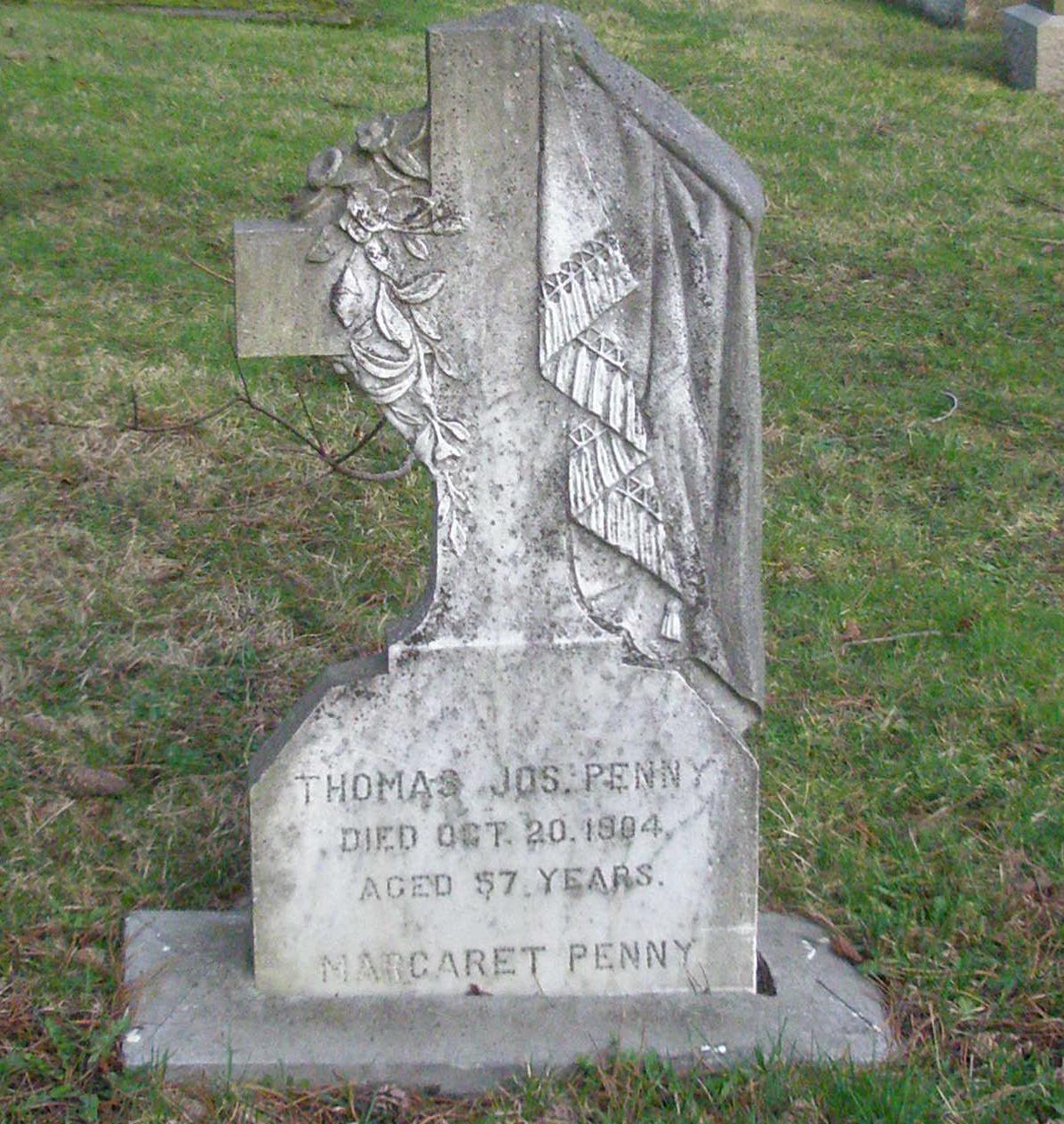
The two genders were also treated differentially in regards to cross ornamentation, as many of female or female dominant crosses have floral decoration, while male and male dominant cross grave monuments do not, the only exception being the male dominate grave monument 6, the west Facing Penny cross grave monument, which does feature a flowered bough. This may suggest that flowers/and or plants were mainly associated with women.

As mentioned earlier, this is a small sample size this may not be an accurate representation. If I were pursuing this further, I would conduct a  larger study of gender representation on a large sample selection of all types of funerary monuments of the time period.

Grave Monument 6 - West Facing Penny Cross Grave Monument


Conclusion:

The ornamentation and styles of the cross monuments selected in Ross Bay Cemetery revealed possible social statuses, heritage, religious beliefs, relationships, gender status, and differential gendered associations of the dead. Large elaborate monuments indicated high social status of the individual they were made for. Celtic crosses revealed possible links to Celtic heritage and Anglican religious affiliations. The different status of genders in the time period may have been demonstrated by more male dominated cross monuments. These monuments demonstrate how identity, religion, male, and female, may continue on, in this case, a hundred years later. While graves keep many secretes they also hold clues to the identity and society of the people buried within them long after their death.


References
Council for Scottish Archaeology Carved Stones Adviser Project, 2006. An introduction to graveyard recording.[online] Council for Scottish Archaeology. Available at: <www.scottishgraveyards.org.uk/downloads/8Introductiontogr.pdf> [Accessed 3 February 2012].
Dethlefsen, E. and Deetz, J., 1966. Death's heads, cherubs, and willow trees: experimental archaeology in colonial cemeteries. American Antiquity, [journal] 31(4), 502-510. Available through: JSTORE [Accessed 3 February 2012].
Garazhian, O. and Yazdi, L.P., 2008. Mortuary practices in Bam after the earthquake. Journal of Social Archaeology, [journal] 8(1), 94-112. Available through: Sage Journal [Accessed 10 January 2012].
Grand Lodge of British Columbia and Yukon, 1920. Edward Gawler Prior obituary. [online](28 February 2001) Available at: <http://freemasonry.bcy.ca/biography/premiers/prior_obit.html> [Accessed 8 February 2012].

Ormsby, M.A., 1971. Sir James Douglas. [online] Available at: <http://www.thecanadianencyclopedia.com/articles/sir-james-douglas> [Accessed 8 February 2012].

Stiver, D. n.d., Vines. [online] Available at:<http://www.crosscrucifix.com/glossaryhome.htm> [Accessed 8 February 2012].

Walker, S., 1997. Celtic cross. [online] Available at: <http://www.celtarts.com/celtic.htm> [Accessed 12 February 2012].